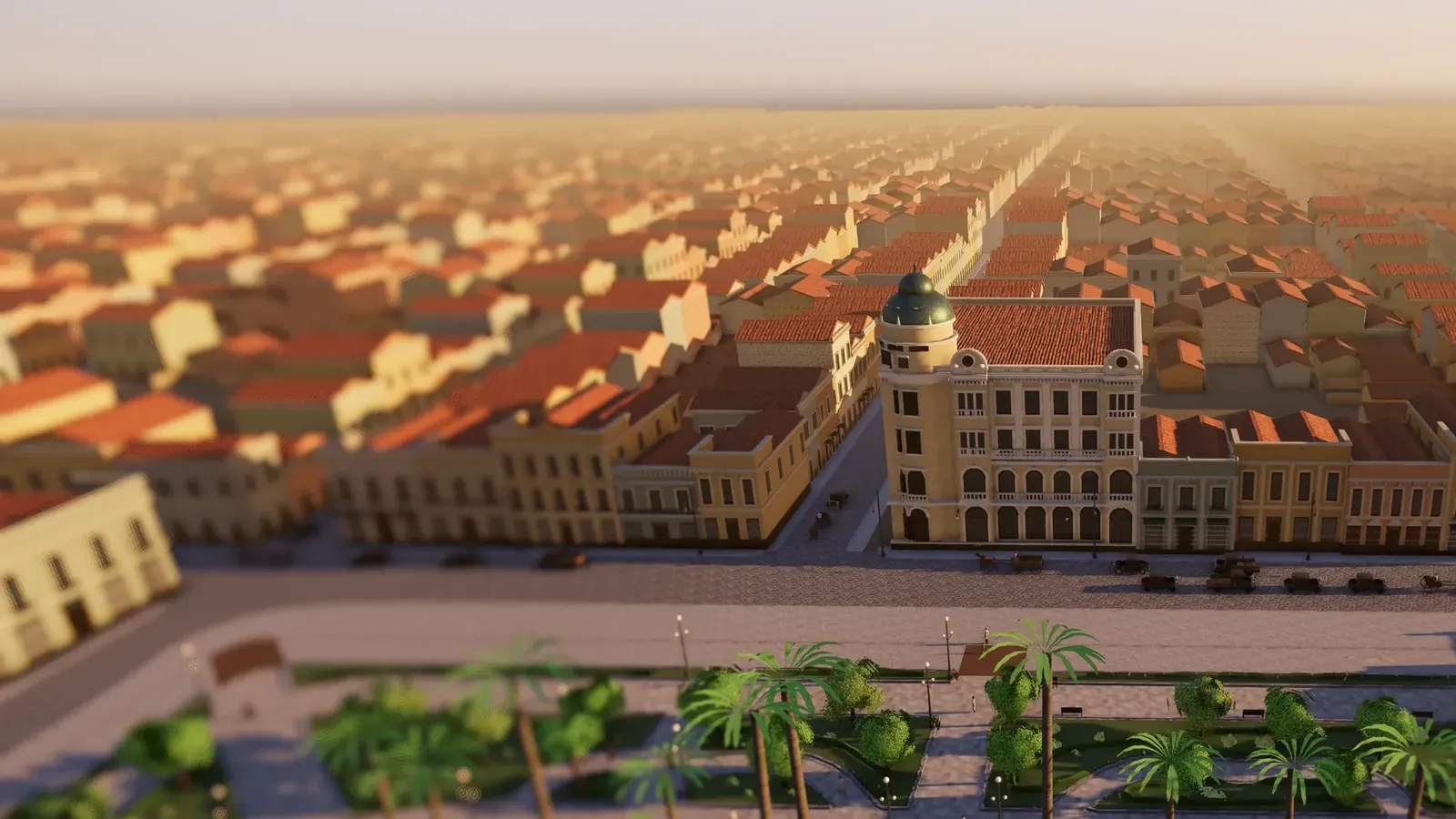
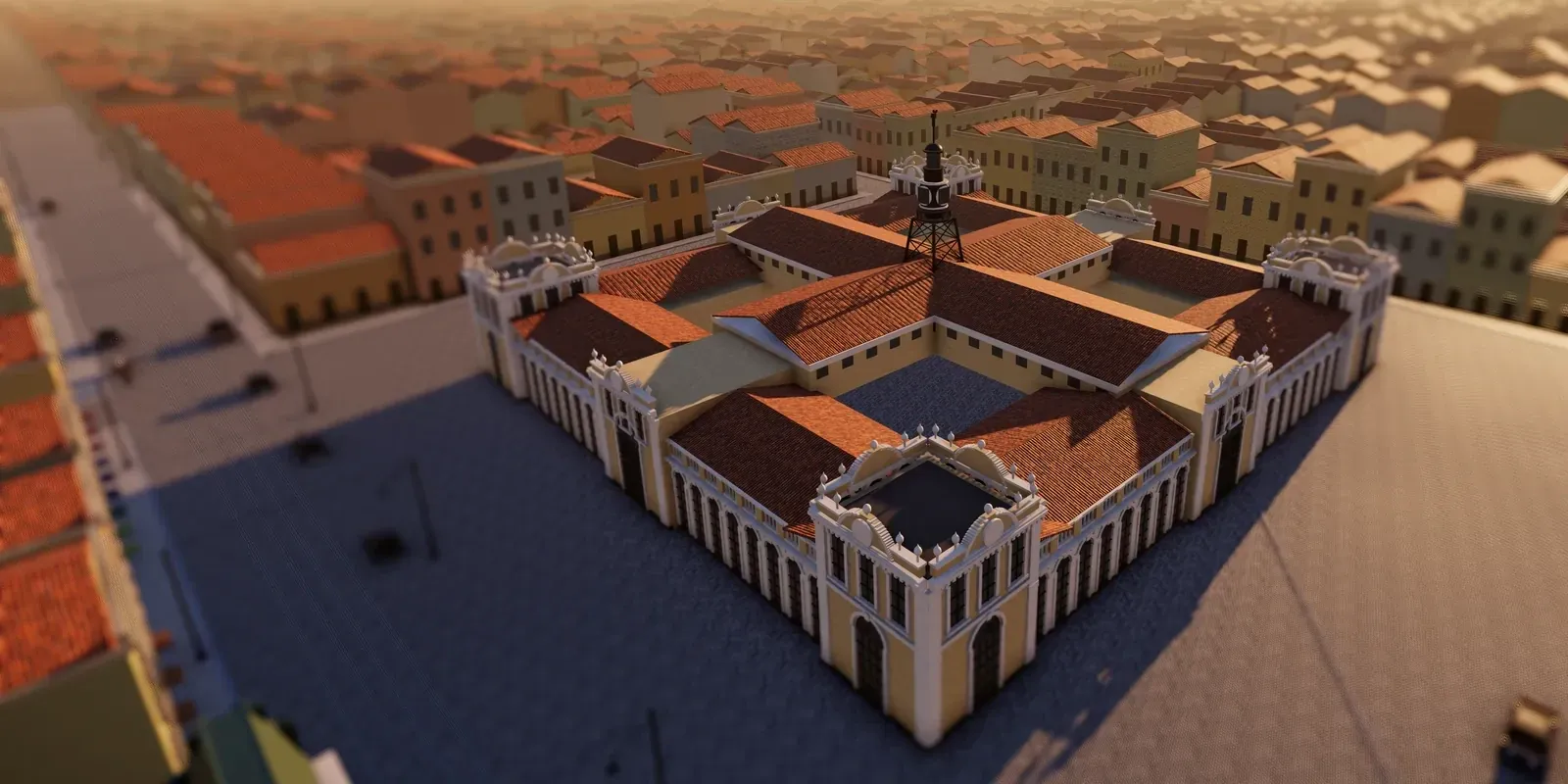
Anyone walking through Coronel Pedro Osório Square today, in central Pelotas in southern Brazil, encounters a place that has changed along with the city. In Pelotas 1935, the interactive experience I created, the idea is to visit a reconstruction of this space in another era: to observe the square, approach its landmarks and discover their stories, directly in a web browser.
I had already been exploring the memory of Pelotas through film and video. This time, I wanted to try building a three-dimensional place that people could explore for themselves. Rather than only following the framing and timing of a video, visitors can choose where to look and which part of the environment to spend time in.
The idea began as an experiment: how far could I take a creative project by working in dialogue with artificial intelligence tools? I led the research, visual direction and decisions, using those tools to investigate references and build the project.
A square gradually revealed by research
The choice of 1935 came from the photographs and documents available for that period. They made it possible to work with a layout of the square that differs from the one we know today. It was not enough to place old buildings in a scene: I needed to understand how the paths, gardens and façades related to one another.
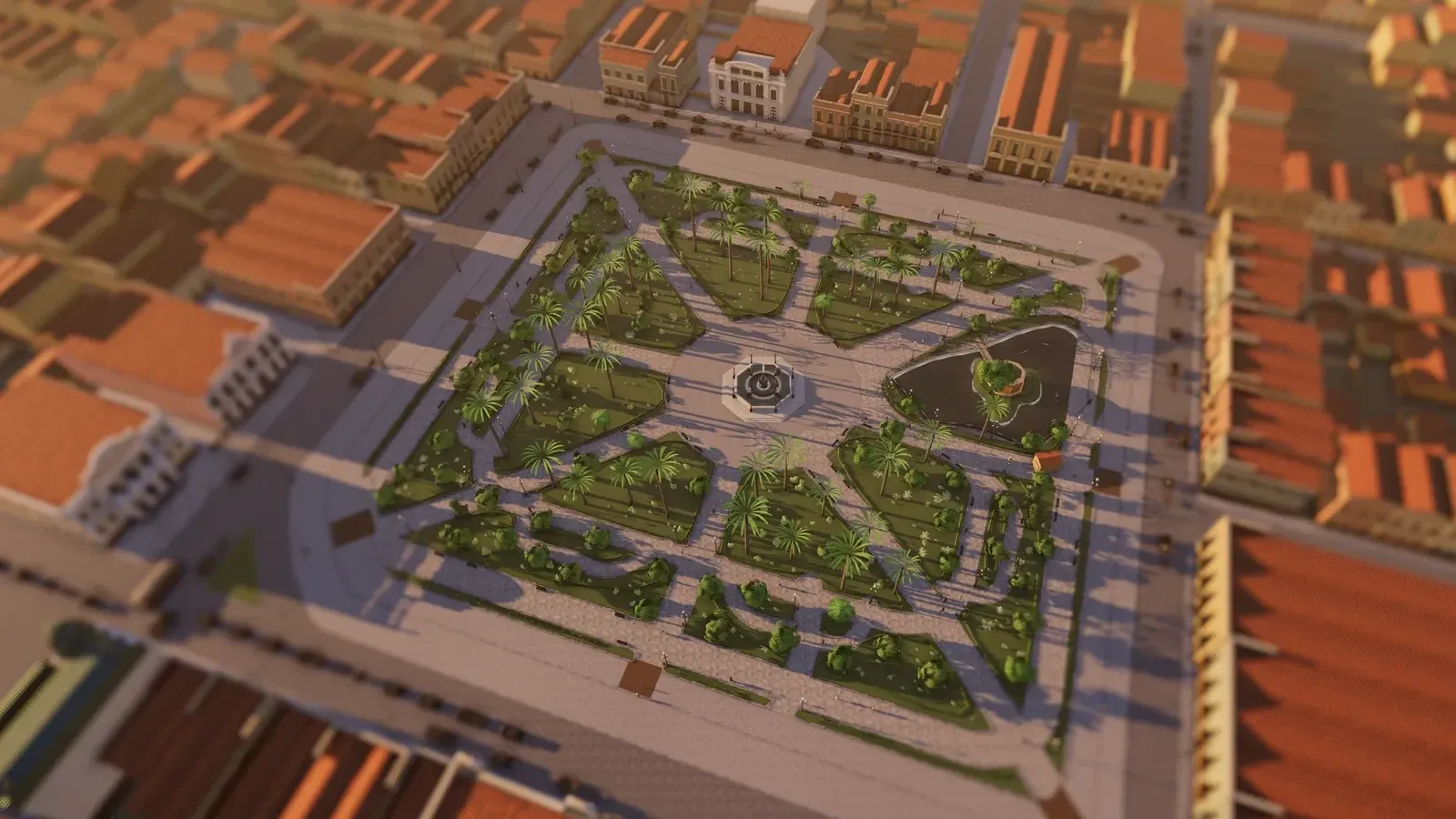
Research, modelling, writing and programming developed together. Finding a new photograph could change a decision already made about a building or the layout of the square. Testing, looking at the result and making corrections were part of the proposal from the start.
The garden layout is one example. We could not locate an original plan that resolved that configuration, so the paths had to be reconstructed by comparing aerial photographs. Some decisions were supported by documentation; others required interpretation. I tried to make that distinction clear.
How the environment was built
The work combined models built in Blender with programming in Three.js, the technology used to display and navigate the three-dimensional environment in a browser. Historical references guided the proportions, façades, paths and features such as the Fonte das Nereidas fountain.
I used Anthropic's Claude during research and development, and OpenAI's Codex also contributed to the final stages and revisions. AI helped cross-reference sources, organise information and develop parts of the system. I evaluated the results and decided what needed to change. It took many rounds of comparison and correction to reach the published experience.
From construction to a public visit
I started on 29 July 2026, and the first version was built by 31 August. In the first days of September, I made the final adjustments and prepared the presentation. The public launch took place on 4 September; afterwards, I continued improving loading and navigation.
Making the environment accessible in a browser was an important part of the idea. People would not need to install a program to discover the project. It also meant making decisions about how much detail could be included without making access difficult.
No historian was directly consulted during production. The work drew on existing research and publications, together with old photographs, postcards, newspapers and documents. Those researchers' work was essential. The reconstruction remains open to contributions and corrections, without presenting interpreted details as historical certainties.
For me, there is particular value in presenting a place familiar to people in Pelotas in a configuration many know only through photographs. I hope curiosity about the visuals also brings visitors closer to the research behind the project.
Explore Pelotas 1935 or read about the research and sources.