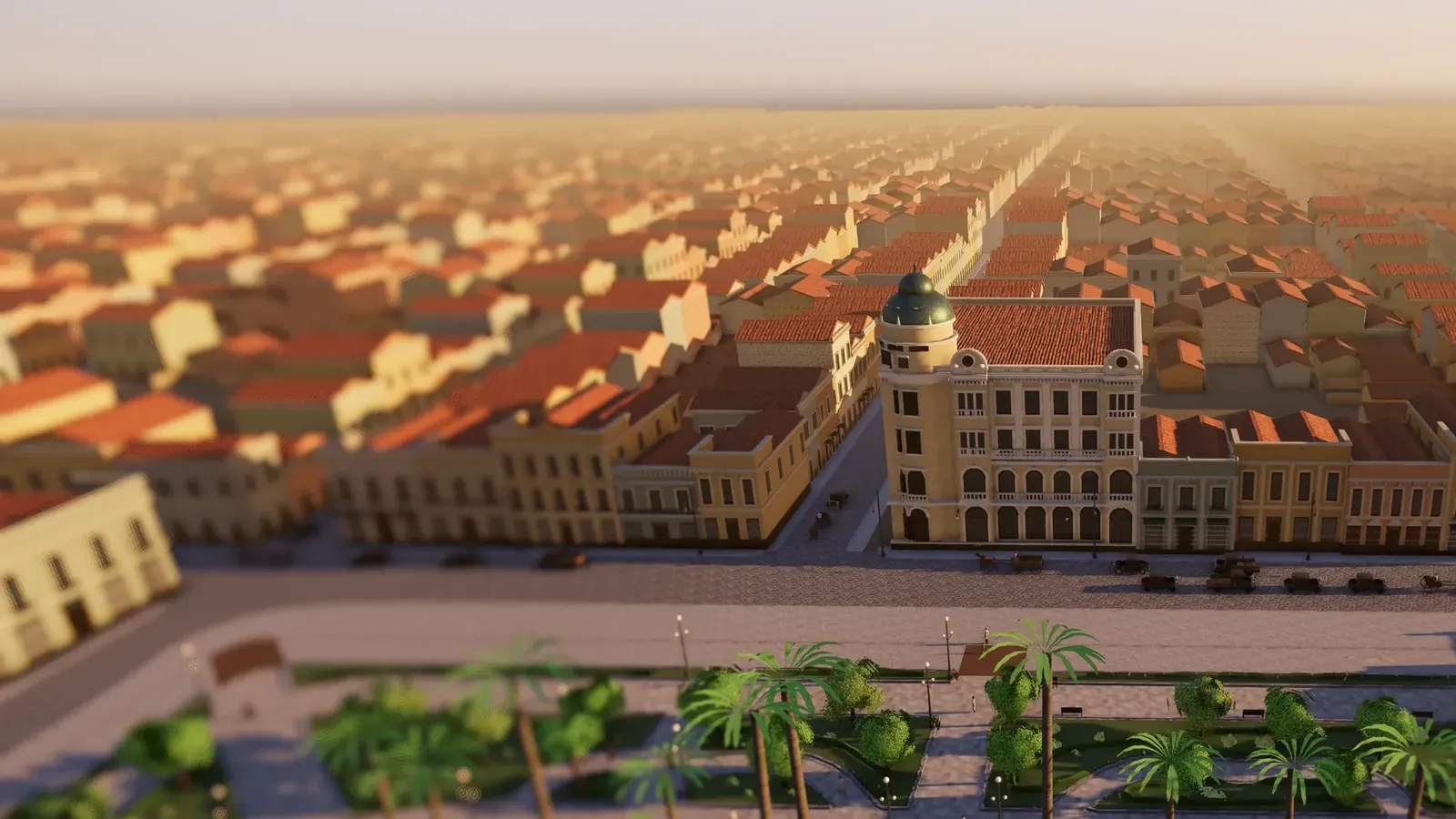
Pelotas 1935 is an experience I created to let people visit a reconstruction of Coronel Pedro Osório Square and its surroundings in central Pelotas, in southern Brazil, through a web browser. To build this place in three dimensions, historical references had to inform decisions from the beginning, rather than simply illustrate the finished work.
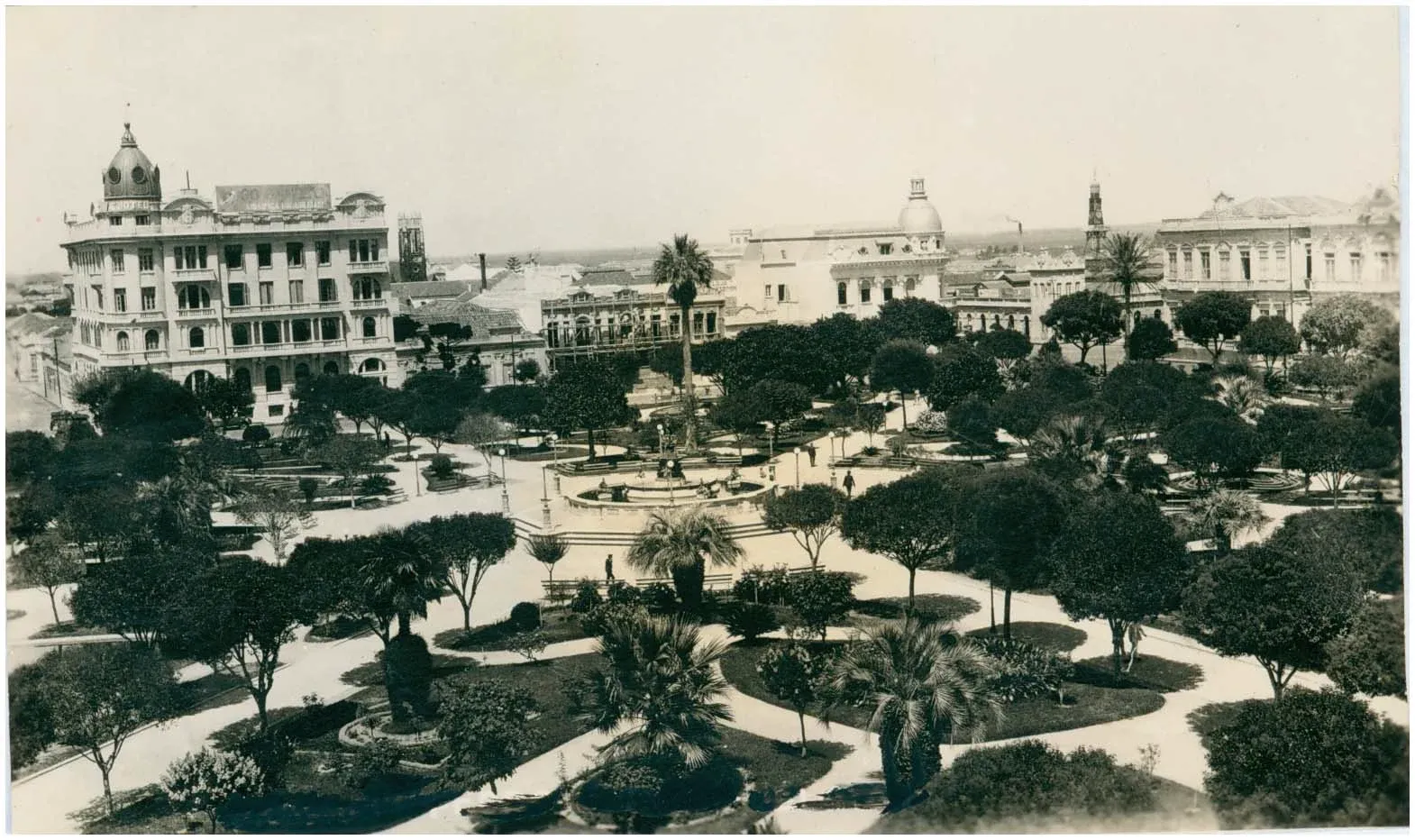
The work drew on existing research and publications, old photographs, postcards, newspapers and documents. I consulted collections such as that of IBGE, Brazil's geography and statistics institute, and researchers' work on the square, architecture and urban life in Pelotas. I did not speak directly with a historian during production.
The question of the paths
One challenge was the garden layout. We could not locate an original plan that resolved the configuration used in the project. The paths therefore had to be reconstructed by comparing aerial photographs.
This made research and construction part of the same process. A new reference could require revising something already modelled. It was not a matter of collecting images, finishing the research and only then beginning production: the two kept intersecting.
Finding a new photograph could change a decision already made about a building or the layout of the square.
From references to façades
The same care guided the proportions and façades of the surroundings. The experience does not present an isolated garden: the buildings help visitors understand where that space sits and how it relates to the city centre.
I used artificial intelligence tools to help cross-reference sources and organise information. That interaction was part of the experiment, but the results still needed to be examined and decisions revisited. Having a tool did not remove the uncertainties in the source material.
What is documented and what is interpreted
I tried to distinguish these two situations when presenting the project. A reconstruction can bring people closer to a place and spark curiosity without claiming to have filled every gap in its history.
That is why the sources are available alongside the experience, and the project remains open to contributions and corrections. The researchers' work supports this reconstruction and allows other people to see where the information came from.
Read the sources and introduction to Pelotas 1935. For more on the technical work and the visit itself, read how the square became an interactive experience.